

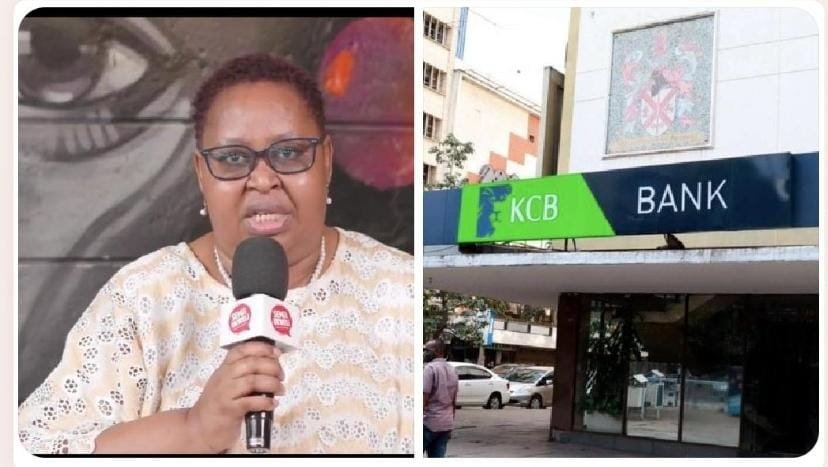
The case of Lillian Karani, a former employee of Kenya Commercial Bank (KCB), has raised serious concerns over how workplace injuries are handled, particularly when employees suffer long-term health consequences in the line of duty.
Karani, who served the bank for nearly 29 years, says her life changed irreversibly following a violent robbery incident in Kisumu in 2012. What began as a routine workday ended in a traumatic attack that would later define her health, career, and prolonged struggle for compensation.
At the time, Karani was stationed at KCB’s United Mall branch in Kisumu, where she worked as an operations manager. Due to extended working hours guided by Central Bank of Kenya prudential guidelines, she often left work late, tasked with ensuring that all cash and documentation were securely balanced and stored.
On November 21, 2012, she left the workplace at around 8:15 p.m. Barely ten minutes into her journey home, she was ambushed by four armed attackers—three wielding machetes and one carrying a firearm. The assailants assaulted her, leaving her with severe head injuries, and made away with personal belongings, including sensitive bank materials such as keys and documents.
Karani maintains that, despite the known risks associated with late working hours, she was not provided with transport, unlike unionised staff who were routinely facilitated due to the nature of their shifts. This, she argues, exposed her to the attack.
Following the incident, she was assisted by neighbours before the matter was reported. However, her condition deteriorated rapidly. She was first admitted to Aga Khan Hospital Kisumu, where she slipped into a coma and was placed in intensive care for five days. Due to the severity of her injuries, she was later airlifted to Aga Khan University Hospital in Nairobi, where she remained admitted for about a month.
Although she eventually returned to work, Karani says her health never fully recovered. Over the years, she continued to experience complications linked to the attack. In 2018, after seeking assistance from the bank’s human resource office, she was transferred to a less demanding role at the head office following a meeting with then HR director Paul Russo.
Despite the adjustment, her condition continued to worsen, culminating in her medical retirement on November 5, 2021. Medical assessments reportedly indicated that her condition was permanent and unlikely to improve with further treatment.
It is what followed after her retirement that has now drawn scrutiny.
In July 2024, Karani initiated a disability claim through KCB’s internal insurance structures. She states that while her claim was acknowledged, the process that followed was marked by delays, inconsistencies, and a lack of transparency.
Initially, she was informed that her claim had been declined by Jubilee Insurance, which had previously compensated her for temporary disability shortly after the 2012 incident. However, she says she was not provided with any formal documentation to support the alleged rejection.
Subsequently, she was advised to pursue compensation under a critical illness policy with APA Insurance. This raised concerns, as her condition stemmed from a physical injury rather than illnesses typically covered under such policies.
Frustrated by the back-and-forth, Karani escalated the matter to the Insurance Regulatory Authority (IRA) in early 2025.
According to her account, findings from the regulator painted a troubling picture. Jubilee Insurance reportedly indicated that no claim had been submitted on her behalf by KCB following the initial compensation in 2014. This contradicted earlier communication suggesting that her claim had been declined.
At the same time, APA Insurance is said to have acknowledged that while there was no issue with processing claims in general, the policy under which Karani’s claim had been lodged was inappropriate. The insurer reportedly stated that her condition did not fall under the critical illness cover used in the application.
The IRA is said to have confirmed that the claim had been lodged under the wrong policy and that it could not compel the insurer to compensate for a risk that was not covered.
Further developments in September 2025 added another layer to the dispute. Karani received a letter from KCB addressed to Jubilee Insurance, formally notifying them of her injury and seeking compensation under a work-related injury framework. The letter reportedly acknowledged that her injury occurred in the course of duty and classified it as a work injury case.
This raised questions about why such communication had not been initiated earlier, particularly given the severity of the incident and the length of time that had elapsed.
Separately, Karani took her case to the Ministry of Labour under the Work Injury Benefits Act (WIBA). According to her, it emerged that her employer had not formally reported the injury as required under the law. Additionally, mandatory forms that are typically completed by employers in such cases had not been filed.
She says she was forced to initiate parts of the process herself, including having medical documentation completed and submitted, despite this being the responsibility of the employer.
The impact of the incident on her life has been profound. Karani says she now requires constant care and continues to rely on medication due to the long-term effects of the injury. Her ability to live independently has been significantly affected.
Beyond her personal circumstances, she argues that her case highlights broader concerns about workplace safety and the enforcement of employee protection laws.
Her experience raises key questions: What happens when an employee is injured while performing their duties? Are employers consistently meeting their legal obligations under work injury compensation frameworks? And what recourse do employees have when processes appear to fail?
Karani maintains that her pursuit is not only about personal compensation but also about accountability and dignity. Having dedicated nearly three decades of service to the bank, she believes that her case deserves fair handling and resolution.