
For two decades, one assumption has dominated Ukambani politics: the region belongs to Kalonzo Musyoka and Wiper.
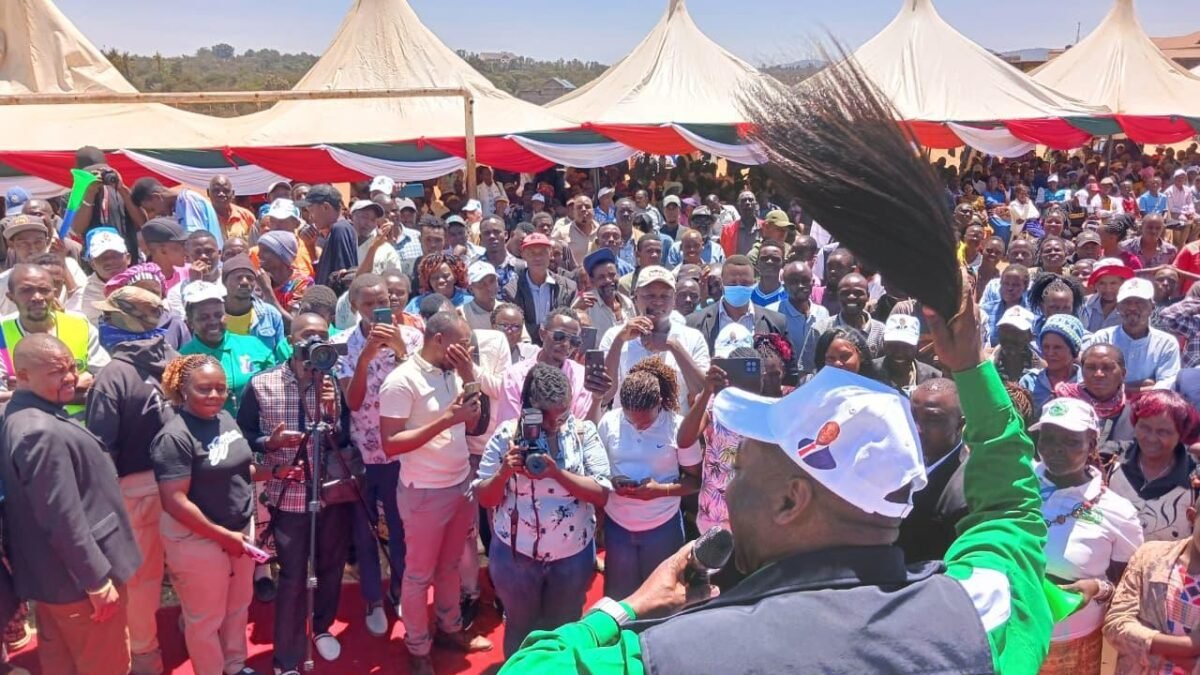
But after the National Liberal Party (NLP) drew more than 6,000 supporters to Kitui Stadium on 13 August 2026, that assumption can no longer be taken for granted.
The rally, held at the same venue where Wiper Senator Wambua Kiio had addressed a smaller gathering days earlier, was more than another political meeting. It was a statement of intent — and a challenge for the political soul of Ukambani.
“WE WILL BARGAIN, NOT BEG”
Addressing a charged crowd, NLP Party Leader Dr. Augustus Kyalo Muli drew a clear line.
“NLP will work with either opposition or government. But we are not going to beg. We are going to bargain and fight for our people. We are also willing to go alone.”
The declaration came a month after NLP resolved to engage all political formations “in pursuit of the interests of the Kamba community.”
Muli also confirmed that he will contest the Kitui Central parliamentary seat in 2027 on an NLP ticket.
That decision changes the political equation. NLP is no longer positioning itself simply as another voice in the region; it is seeking to become a serious negotiating force ahead of 2027.
KALONZO UNDER PRESSURE
The development presents a direct challenge to Wiper.
Muli has said previous attempts to engage Kalonzo Musyoka had “not received a response”, while questioning whether decades of established political leadership have delivered sufficient gains for the Kamba community.
In an earlier statement, Muli argued:
“45 years of Kalonzo’s leadership have not benefited the community. It is time for new leaders to rise.”
Whether voters agree with that assessment will be tested at the ballot. But politically, the message is clear: NLP intends to challenge the assumption that Wiper has an automatic claim on the Ukambani vote.
The Kitui Stadium turnout has given that argument visibility.
If NLP can convert its growing public presence into votes, Wiper faces a more competitive landscape in its traditional stronghold. The question is no longer whether NLP can attract attention; it is whether it can translate momentum into electoral strength.
For Wiper, the strategic choices are now clear: engage NLP, confront it, or negotiate with it.
Ignoring it may no longer be enough.
RUTO SEES AN OPENING
President William Ruto and Kenya Kwanza have struggled to make major inroads into Ukambani since 2022.
NLP’s willingness to engage both government and opposition, however, creates an opening.
Muli has repeatedly emphasized that his priority is securing tangible benefits for the region rather than committing automatically to either side.
“Our people want development. We will therefore continue to engage the Government,” he said.
For Ruto, that presents both an opportunity and a risk.
A closer relationship with NLP could give the administration a stronger political foothold in Ukambani. But an overly visible alliance could also expose NLP to attacks from rivals who may portray it as a government project.
That is precisely why Muli’s insistence on bargaining rather than begging matters.
NLP wants the flexibility to engage government without surrendering its political independence.
SO, WHO HAS UKAMBANI?
The answer, for now, is simple:
No one does. Not yet.
Kalonzo has political history, an established party structure and national recognition.
Ruto has the power of incumbency, government resources and the ability to deliver development projects.
Muli and NLP are offering something different: a new political vehicle, growing visibility and the promise of a harder bargain for the region.
The 2027 contest may therefore be less about who “owns” Ukambani and more about who can persuade its voters that their political choices will deliver the greatest return.
For decades, Ukambani has often been treated as a reliable political bloc.
That may be changing.
As Muli put it:
“Our voice is going to be very important in 2027. Ukambani will no longer be delivered on a silver platter.”
The next 12 months will determine whether that voice becomes a bargaining chip, a political force in its own right, or the foundation of a new alliance.
Ukambani may still vote together in 2027.
But increasingly, the bigger question is not whether Ukambani will bargain.
It is who will have to negotiate with whom?
END