
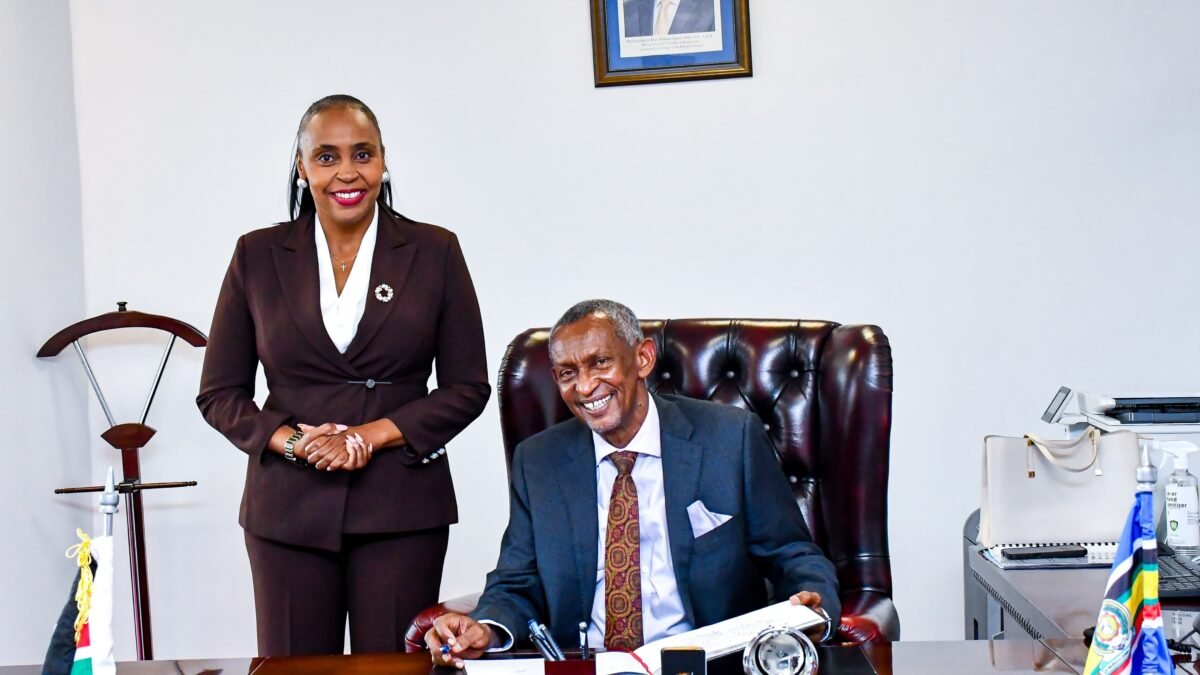
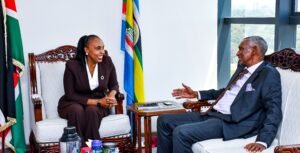
Principal Secretary for East African Community Affairs and acting Principal Secretary for Arid and Semi-Arid Lands (ASALs) and Regional Development Dr Caroline W. Karugu has held talks with Equalisation Fund Advisory Board Chairman Ambassador (Eng.) Mahboub Maalim on development and inclusion of marginalised communities.
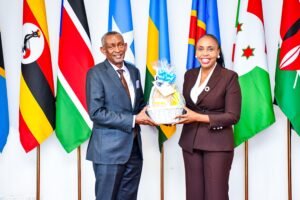
Karugu hosted Maalim at her office on Thursday for what the State Department described as a strategic consultative meeting focused on improving access to basic services and unlocking economic opportunities in ASAL and marginalised regions.
Maalim chairs the Equalisation Fund Advisory Board, which oversees a constitutional affirmative action mechanism aimed at bringing basic services in marginalised areas to standards enjoyed in other parts of the country.
The meeting focused on three key areas: financing essential infrastructure through the Equalisation Fund, promoting socio-economic integration, and advancing human capital development and the realisation of fundamental rights.
According to the State Department, remote and ASAL regions have faced decades of underinvestment, limiting economic growth and access to essential public services.
The Equalisation Fund seeks to address these disparities by directing resources towards priority areas, including construction of health dispensaries, drilling of high-capacity solar-powered boreholes and expansion of last-mile electricity connectivity to households and public institutions.
Road infrastructure was also highlighted as an important component of economic integration. Improved local road networks are expected to connect remote agricultural and pastoralist communities to national markets, reducing transportation costs and post-harvest losses.
Reliable access to water and electricity could also help transform local trading centres into hubs for micro-enterprises, value-addition activities and digital inclusion.
The discussions further highlighted the importance of access to clean water, healthcare and education as fundamental rights under Article 43 of the Constitution.
Improved service delivery, the State Department said, could contribute to better maternal and child health outcomes, reduce waterborne diseases and improve school retention, particularly among girls who often bear the burden of travelling long distances to fetch water.