

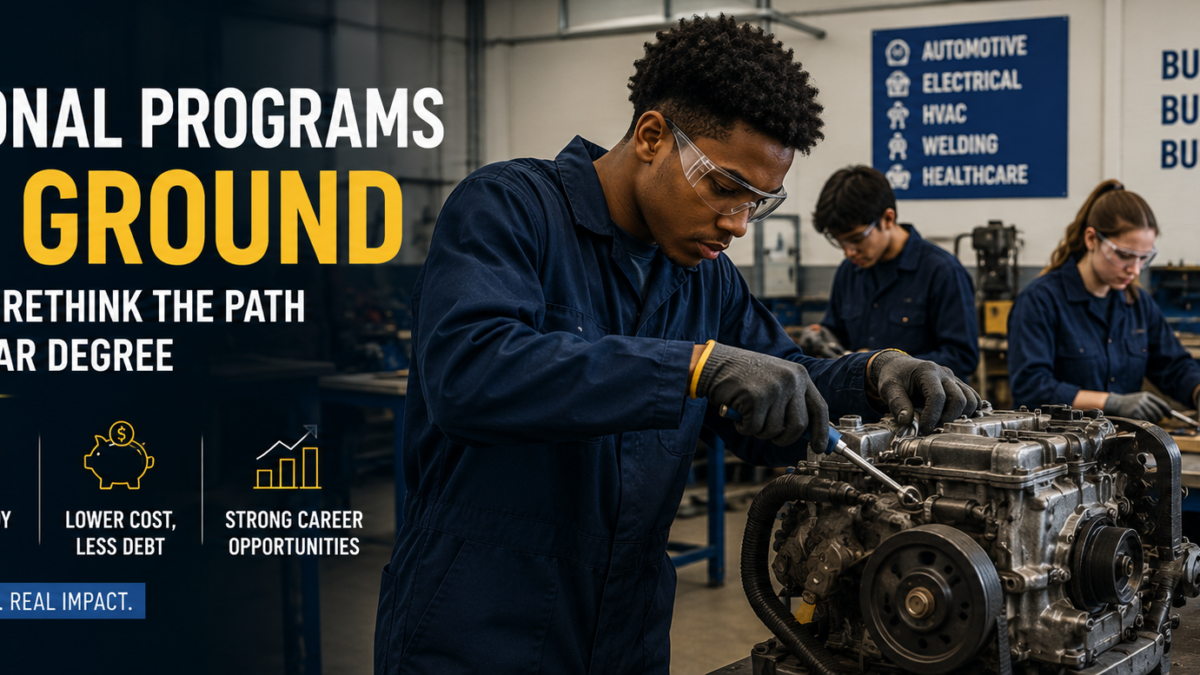
Enrollment in vocational and technical training programs is rising across the United States, as a growing number of high school graduates weigh the cost of a four-year college degree against more direct routes into skilled trades and technical careers.
Community colleges and trade schools in several states have reported enrollment increases in programs such as welding, electrical work, plumbing, and advanced manufacturing over the past two academic years, reversing a longer-term decline in vocational enrollment that dates back decades. Education researchers attribute the shift to a combination of rising college tuition, persistent student loan debt concerns, and reported labor shortages in skilled trades that have pushed starting wages higher in some regions.
“Parents who once would have insisted their child go straight to a four-year university are increasingly open to other paths, particularly when they can see a clear wage outcome attached to a shorter, less expensive credential,” said an administrator at a regional technical college who has tracked enrollment patterns over the past several admissions cycles.
The shift has been reinforced by policy changes at the state level. A number of states have expanded funding for high school career and technical education programs in recent years, including dual-enrollment arrangements that allow students to earn industry certifications while still in high school. Some states have also introduced free or reduced-cost community college tuition for students pursuing credentials in fields designated as high-demand, often including healthcare support roles, information technology, and various skilled trades.
Labor market data lends some support to the trend. Government projections have pointed to continued demand growth in several skilled trade occupations over the coming decade, driven in part by an aging workforce in fields such as construction and manufacturing, where a substantial share of current workers are nearing retirement age. Industry groups in construction and manufacturing have for years warned of looming labor shortages, citing both demographic trends and a decades-long cultural emphasis on four-year degrees that they argue diverted students away from trades.
Wage data presents a more nuanced picture. While median earnings in many skilled trades have risen, a four-year college degree still correlates with higher average lifetime earnings across the broader labor market, according to most published economic research. Proponents of vocational pathways argue that the comparison is incomplete unless it accounts for the absence of student loan debt and the multi-year head start in earnings that trade graduates typically gain over their college-attending peers.
Not all vocational programs report the same momentum. Enrollment growth has been concentrated in trades tied to construction, energy, and manufacturing, while some other technical fields have seen more modest gains. Officials at several technical colleges said the variation closely tracks regional economic conditions, with growth most pronounced in areas experiencing active construction booms or significant manufacturing investment.
The renewed interest in vocational education has prompted some high schools to reinvest in career and technical education facilities that had been scaled back in past decades as schools redirected funding toward college preparatory coursework. Rebuilding that infrastructure, school officials say, requires not only capital investment in equipment such as welding bays or automotive shops but also recruiting instructors with relevant industry experience, a process complicated by the fact that skilled tradespeople often earn more in private industry than school districts can offer in teaching salaries.
Some education researchers caution against overstating the shift. Despite recent gains, vocational and technical enrollment remains well below the levels seen several decades ago, before many high schools narrowed their course offerings. Four-year college enrollment, while it has softened somewhat in certain demographic groups, still represents the path taken by the majority of high school graduates who continue their education immediately after graduation.
There are also questions about how durable the current enrollment trends will prove. Economists who study education and labor markets note that interest in vocational training has historically been cyclical, often rising during periods when college costs are widely discussed in the media and falling back once anxieties about tuition recede or when a broader economic downturn reduces demand for skilled trade labor tied to construction and manufacturing.
Employers in several industries have taken a more active role in shaping vocational curricula, partnering directly with technical colleges and high schools to design training programs aligned with specific equipment and certifications used in their workplaces. Apprenticeship programs, which combine paid on-the-job training with classroom instruction, have also expanded, supported in part by federal grant programs aimed at increasing the number of registered apprenticeships across a range of industries beyond the building trades where such programs have traditionally been concentrated.
Community college officials say the renewed interest has required adjustments beyond enrollment numbers alone. Several reported waiting lists for popular programs such as welding and electrical technology, driven by both rising student interest and capacity constraints tied to limited classroom and laboratory space. Expanding capacity often requires new capital funding, which in many states must compete with other higher education priorities during annual budget negotiations.
Students who have chosen vocational pathways describe a range of motivations beyond cost alone, including a preference for hands-on work and a desire to enter the workforce more quickly. Several students and recent graduates interviewed for related reporting described feeling that vocational programs offered clearer, faster connections between coursework and employment than they perceived in more traditional college pathways, though they also acknowledged that not every trade offers the same long-term advancement opportunities without further training or licensure.
For policymakers, the renewed attention to vocational education has become intertwined with broader debates about the value and cost of higher education generally. Several states have introduced legislation this year aimed at expanding access to career and technical education earlier in students’ academic careers, including in middle school, reflecting a view among some education officials that exposure to trade and technical careers should begin well before students are finalizing post-secondary plans.
Whether the current enrollment gains in vocational education represent a durable structural shift in how American students approach the transition from high school to career, or a temporary response to a particular economic moment, remains uncertain. What is clearer, according to officials across multiple states, is that the conversation about what comes after high school has broadened considerably from where it stood a decade ago, with skilled trades occupying a more prominent place in that discussion than they have in many years.
Financing remains a complicating factor even as overall costs for vocational programs stay well below those of four-year institutions. Many trade certification programs fall outside the scope of traditional federal financial aid in ways that surprise some families, particularly shorter programs that do not meet minimum credit-hour thresholds required for certain grant and loan eligibility. Several states have introduced their own grant programs to fill this gap, but advocates for expanding access say the patchwork of eligibility rules across federal and state programs can be difficult for students and families to navigate without dedicated guidance counseling, which is itself in short supply at many high schools.
Gender disparities in vocational enrollment persist despite recruitment efforts aimed at broadening participation. Fields such as construction, electrical work, and automotive technology remain heavily male-dominated, while vocational programs in healthcare support roles and cosmetology remain predominantly female. Some industry associations have launched outreach campaigns specifically targeting young women for trades with historically low female participation, citing both a desire for greater workforce diversity and practical labor shortages that make a broader applicant pool valuable to employers regardless of other considerations.
Community perceptions of vocational education continue to shift gradually rather than abruptly. School counselors interviewed for related coverage said that conversations with parents about post-graduation plans increasingly include trade pathways as a legitimate option presented alongside four-year college, rather than as a fallback discussed only with students who counselors believe are unlikely to be admitted to a university. Several counselors described this as a meaningful change from how such conversations were structured even five years ago, though they also said that some lingering stigma around vocational education persists in certain communities, particularly among families where a parent did not have the opportunity to attend college themselves and views a four-year degree as a marker of achieved upward mobility regardless of labor market data about earnings in specific trades.
Industry certification bodies have also adapted, in some cases streamlining the process by which students can stack credentials over time, earning smaller certifications while still in high school or community college that count toward more advanced licensure later. This stackable credential model, increasingly common across welding, healthcare support, and information technology fields, is designed to let students enter the workforce earlier at an entry-level position while continuing to build qualifications part time, rather than requiring a single extended training period before any employment is possible.
Looking internationally, several countries with longer-established vocational education systems, including Germany’s well-known dual education model that closely integrates classroom instruction with paid apprenticeships, continue to be referenced frequently by American policymakers and education researchers exploring how to strengthen vocational pathways domestically. Officials studying these systems caution that direct comparisons are complicated by significant differences in labor market structure, employer involvement in training, and the broader cultural status accorded to vocational careers in different countries, suggesting that any American adaptation of these models would likely need substantial modification rather than simple replication.