
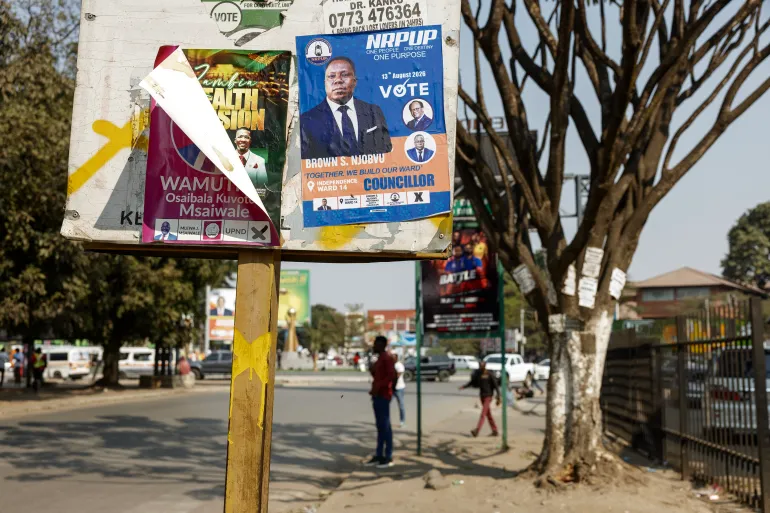
Zambians vote on Aug. 13 in a general election widely seen as a test of whether years of economic reforms under President Hakainde Hichilema have translated into better living standards.
About 8.79 million voters are registered for the election, according to the Electoral Commission of Zambia. Fourteen candidates are contesting the presidency, including Hichilema, leader of the governing United Party for National Development (UPND), who is seeking a second term, and Brian Mundubile, the presidential candidate of the opposition Tonse Alliance.
Hichilema’s government points to progress including Zambia’s debt restructuring and the completion of its IMF-supported programme.
Inflation fell to 6.8% in April, according to the Zambia Statistics Agency. But high food, fuel and electricity costs continue to weigh on households, making the economy a central issue in the election.
Economic record
Joan Chirwa, a Zambian human rights defender, veteran journalist and founder of the Free Press Initiative, said many citizens were yet to see tangible improvements in their daily lives.
“The central question coming from voters is increasingly whether the economic reforms of Hichilema’s first term have translated into tangible improvements in household incomes and living conditions,” Chirwa told Al Jazeera.
She acknowledged progress on debt restructuring and the IMF programme but said macroeconomic stability had not necessarily translated into stronger household welfare, citing continued pressure from food, fuel and electricity costs.
Wellington Muzengeza, an independent political risk analyst and founder of Built Africa, said the election was likely to be shaped by the gap between macroeconomic recovery and the experience of ordinary citizens.
The government can point to debt restructuring, restored international credibility, free education and renewed mining investment. But voters are likely to judge its record by food and transport costs, employment prospects, electricity reliability and the quality of public services, Muzengeza said.
Household pressure
Economic hardship is a major concern for voters, said Levy Ndou, a lecturer in political sciences and public policy at Tshwane University of Technology.
“Political parties need to focus on the 60% of the population living below the national poverty line,” Ndou said, adding that many citizens had high expectations that government could improve their lives.
Unemployment is another major concern, Ndou said, with economic hardship leaving many Zambians frustrated and looking for leaders who can offer practical solutions.
Campaign promises will carry weight only if they translate into tangible improvements in people’s lives, he said.
“The issues they talk about during campaigning should be put into action, which is exactly what ordinary citizens would love to see happening,” Ndou said.
Copper wealth
Copper is another key election issue. The mining sector is a major source of foreign exchange and government revenue, with copper accounting for about 70% of Zambia’s export earnings and more than 10% of gross domestic product.
The government has set an ambitious target of increasing annual copper production to 3 million tonnes.
For Chirwa, however, the debate is not only about raising output but also about how much mining revenue reaches the wider economy.
“We can increase copper production, but how much of the revenue we generate is reaching the wider economy and making the difference that people expect to see?” she said.
Whoever wins the election will face pressure to demonstrate that higher mining revenues are benefiting the wider population, Chirwa said.
“The focus should extend beyond output figures to the wider impact of the mining sector,” Muzengeza said. Voters, particularly on the Copperbelt, will want to know whether mineral wealth is creating secure jobs, local procurement opportunities, stronger communities and sufficient public revenue, he said.
Ndou also raised concerns about Zambia’s reliance on copper exports, particularly how the sector is regulated and how its revenues are distributed.
Leaders should establish regulatory frameworks to prevent exploitation of copper resources and ensure that Zambians benefit from the country’s natural wealth, Ndou said.
Debt reform
Debt restructuring is another important measure of Hichilema’s economic record.
“Debt restructuring is a significant achievement because it reduced immediate financing pressure and helped restore Zambia’s international standing,” Muzengeza said.
But progress on sovereign debt does not automatically translate into higher household incomes or improved living standards, he said.
The government therefore has a credible macroeconomic record, but sound economic management must ultimately win broad public support, Muzengeza said.
Political history
Zambia has long been regarded as one of Southern Africa’s stronger examples of multiparty democracy. Since the return to multiparty elections in 1991, six presidents from three political parties have taken office, although some electoral transitions have been marked by political tension.
Hichilema’s path to the presidency was particularly difficult. He narrowly lost the 2015 and 2016 elections to Edgar Lungu and disputed both results.
In 2017, Hichilema was arrested and detained on treason charges before being released. He eventually won the presidency in 2021, succeeding on his fifth attempt.
Now seeking a second term, Hichilema faces a different test: whether the economic reforms pursued during his first term have delivered enough benefits for voters to endorse his government.
For Muzengeza, that question is ultimately at the heart of the election.
“Voters will decide whether recovery has reached ordinary households quickly, broadly and fairly enough,” he said.